From remote mountain worksites to Geofluid 2026: how a real operational challenge led to the development of a new prototype in collaboration with Colli Equipment and TEWATT.
How Do You Deliver an Air Compressor to a Construction Site With No Roads or Trails?
On some construction sites, the first challenge isn’t building the infrastructure itself. It’s getting the machinery and equipment to where the work needs to happen.
This is especially true in mountainous terrain, on steep slopes and in remote areas without road access. In these locations, constructing and maintaining power lines calls for logistical solutions that go far beyond conventional construction methods.
Sometimes, the only practical way to transport people, materials and equipment is by helicopter.
But what happens when a machine is too heavy to be lifted in one piece?
That challenge inspired the development of Romei Group’s new helicopter-transportable air compressor, unveiled at Geofluid 2026, the international exhibition dedicated to drilling, special foundations and underground construction technologies, held in Piacenza, Italy, from 7 to 10 October.
The project reflects a principle that has long guided Romei Group’s approach to innovation: identifying the difficulties encountered on real construction sites and developing equipment that makes operations simpler, faster and safer.
When Construction Sites Are Inaccessible, Machinery Must Adapt
Romei Group has extensive experience in overhead power line construction and maintenance, specialist foundation works and slope stabilisation projects in challenging environments.
To operate in these conditions, the company has progressively developed a fleet of specialised helicopter-transportable machinery, designed around the practical requirements of remote worksites.
The fleet includes compact excavators, specialised drilling equipment and Marini MR20 drilling rigs, adapted to meet Romei Group’s specific operational needs.
One of the main challenges is logistics.
For certain helicopter transport operations, individual loads must remain within an indicative weight limit of approximately 1,100 kg, depending on the helicopter’s lifting capacity, flight conditions and operational requirements.
Heavier machinery must therefore be dismantled into smaller components, transported in separate lifts and reassembled at the construction site.
These procedures can be demanding even in a fully equipped workshop. Performing them on a steep mountainside, with limited space and difficult environmental conditions, adds an entirely different level of complexity.
Over the years, this challenge has led Romei Group to rethink how its machinery is designed, transported and assembled.
From Three Days to 35 Minutes: The Experience Behind the Marini MR20
One example of this approach is the Marini MR20 drilling rig, developed to meet the specific requirements of Romei Group’s remote construction projects.
According to the company’s operational experience, dismantling and reassembling a conventional drilling rig could require approximately three working days involving three mechanics.
With the configuration developed for the MR20, the corresponding operations can be completed in approximately 35 minutes, according to Romei Group.
This improvement comes from designing the equipment with helicopter transport and on-site assembly requirements in mind from the outset.
The helicopter itself can assist with lifting and positioning components during dismantling and assembly, reducing the need for additional lifting machinery on site.
The benefits extend well beyond time savings.
Simpler procedures can reduce complex manual handling operations, limit the time workers spend performing demanding tasks in difficult environments and improve overall project efficiency.
The same design philosophy inspired Romei Group to rethink another essential piece of equipment: the air compressor.
The Compressor Challenge: Too Heavy and Too Complicated to Dismantle
In specialised drilling operations, air compressors supply the compressed air required by certain drilling techniques and equipment.
For Romei Group, however, conventional compressors created a particular logistical problem.
Their weight often made it necessary to dismantle them before helicopter transport.
And dismantling an industrial air compressor is far from straightforward.
According to Romei Group’s experience, taking a conventional compressor apart can require at least one full working day, followed by another day to reassemble it once the components have reached the construction site.
The process also involves handling heavy components, arranging suitable lifting equipment and managing the difficulties of reassembly in remote locations.
The company had considered alternative approaches, including operating multiple compressors connected in line, but these solutions did not deliver satisfactory results.
Eventually, a different question emerged:
What if, instead of repeatedly dismantling the compressor, the machine itself could be made light enough to travel in one piece?
From Roberto Romei’s Idea to a Project With Colli Equipment and TEWATT
The idea originated from Roberto Romei’s direct experience in the field and evolved through collaboration with specialist industrial partners.
Romei Group involved Fabio Colli of Colli Equipment, a long-standing supplier who helped refine the concept and define its technical requirements.
The construction of the prototype was entrusted to TEWATT, a manufacturer of industrial compressors and equipment.
Rather than developing an entirely new machine from scratch, the project focused on adapting an existing compressor platform to the demands of construction sites accessible only by helicopter.
The development work concentrated on three key areas:
- A lighter structure: using aluminium frames to reduce the overall weight.
- An optimised power unit: adopting a lighter, more powerful engine configuration according to the project’s requirements.
- Simplified dismantling and assembly: redesigning key aspects of the configuration to make handling, maintenance and on-site operations easier.
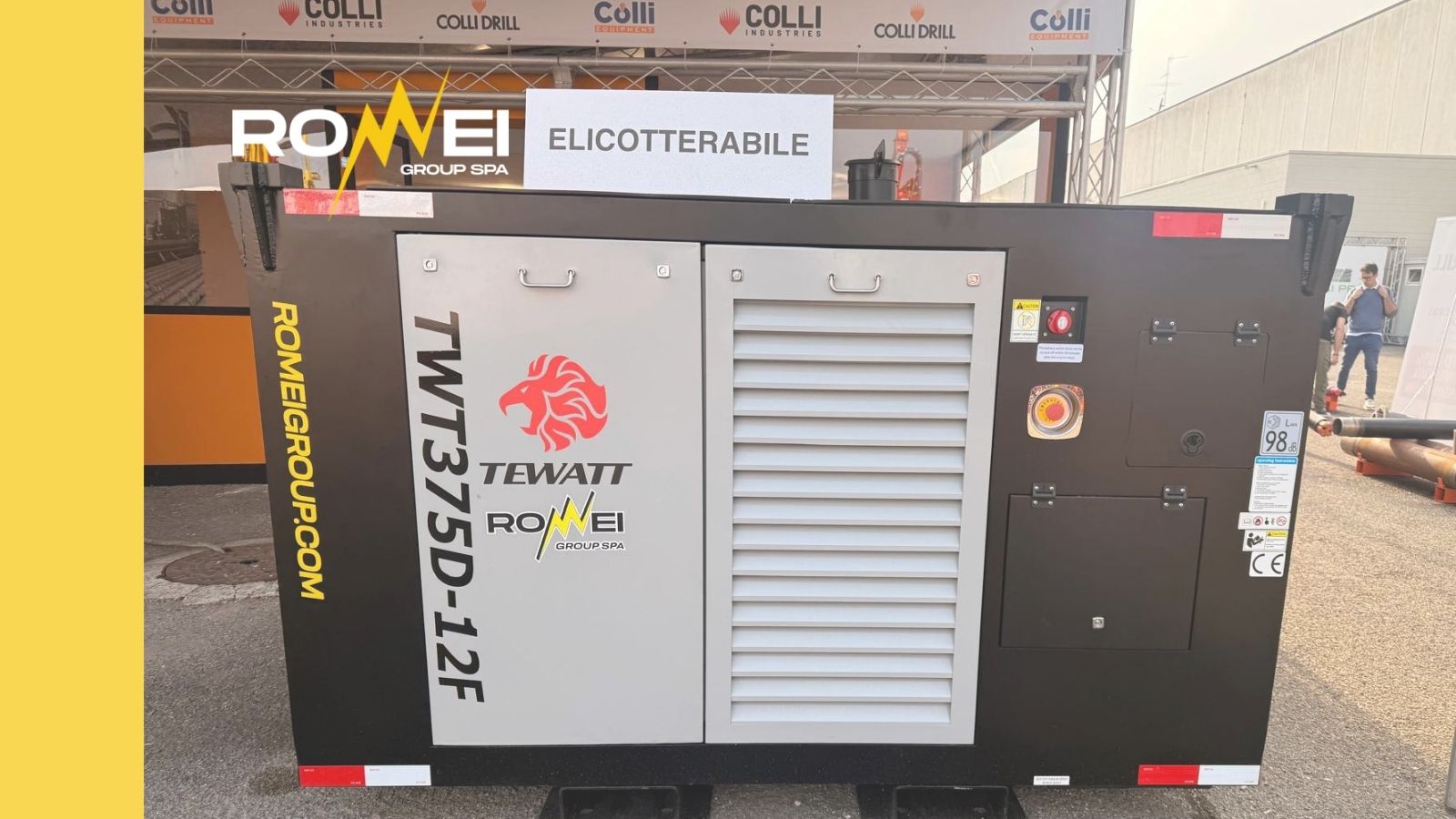
The result is a customised configuration of the TEWATT TWT375D-12F, presented at Geofluid 2026.
The objective was not simply to make an existing machine lighter, but to adapt its design to a highly specific operating environment.
From 1,600 to 1,050 kg: A Weight Reduction of 550 kg
The most immediately measurable outcome of the project is the reduction in overall machine weight.
Compared with a reference compressor weighing approximately 1,600 kg, the new prototype has a total weight of 1,050 kg.
That’s 550 kg less, representing a reduction of approximately 34%.
For construction projects that rely on helicopter transport, this difference can have a significant operational impact.
At 1,050 kg, the new compressor has been designed to be transported in a single helicopter lift, provided that aircraft capacity, weather conditions and site-specific operational requirements allow it.
This would eliminate the need for the extensive dismantling and reassembly procedures associated with heavier conventional compressors.
The potential benefits extend beyond transport itself.
Fewer preparation activities could mean shorter setup times, fewer complex handling operations and more efficient use of equipment and personnel.
The prototype was unveiled at Geofluid 2026 and, following the exhibition, was awaiting collection by Romei Group. Its first operational deployment and field testing will represent the next stage of the project.
Innovation, Efficiency and Safety: Three Goals Behind One Project
Reducing the compressor’s weight is the most visible achievement, but it is only one part of the project’s wider purpose.
For Romei Group, developing machinery that is easier to transport and assemble means addressing three closely connected priorities: saving time, simplifying operations and improving working conditions and safety.
On particularly demanding construction sites, every additional activity involves equipment handling, coordination and physical work in an environment that may already present substantial operational challenges.
Reducing unnecessary handling and assembly procedures can help minimise some of these difficulties, while all lifting and construction activities must continue to follow the applicable safety procedures and site-specific risk assessments.
This philosophy extends beyond the new compressor.
It has shaped the development of other specialised machines that Romei Group has introduced over the years to meet the practical demands of remote infrastructure projects.
There is also an economic consideration.
Machinery that requires less time and fewer resources to prepare for operation can help reduce overall project costs. Over time, these operational savings may help offset the higher initial investment associated with purpose-designed equipment.
For Romei Group, innovation is therefore not an end in itself. It is a way to make demanding construction operations more manageable, efficient and safer for the people carrying them out.
The Most Challenging Construction Sites Inspire New Solutions
The helicopter-transportable air compressor presented at Geofluid 2026 is the result of a development process that began far from the exhibition halls.
It began on mountain construction sites, with the difficulties experienced by the people working there and the ongoing search for more effective ways to overcome them.
The project brings together Romei Group’s field experience, Colli Equipment’s technical contribution and TEWATT’s manufacturing expertise.
The next step will be to put the prototype to work and assess its performance under real operating conditions.
Because when a construction site presents challenges that seem impossible to overcome, the answer is not necessarily to abandon the project.
Sometimes, the solution is to rethink the equipment needed to complete it.
After all, necessity is the mother of invention.