
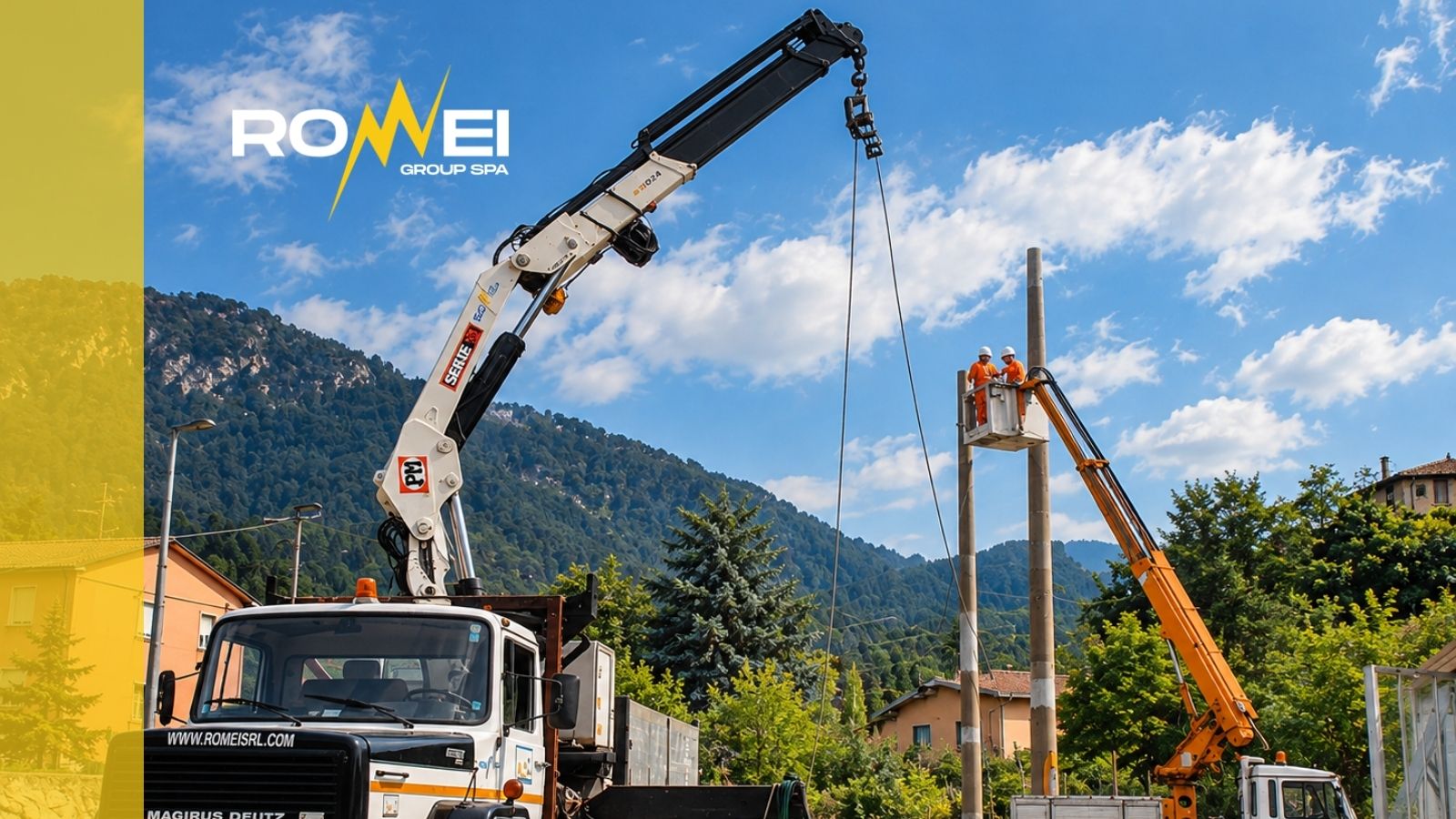
Romei Group’s patented technology for the structural reconstruction of centrifuged reinforced concrete (C.A.C.) poles.
Replacing a Power Line Pole Can Be Far More Complicated Than It Seems
A power line pole begins to show signs of deterioration: the concrete starts to crumble, steel reinforcement may become exposed, and a technical assessment is needed to determine the appropriate intervention.
The first solution that often comes to mind is replacement.
But replacing a pole is not simply a matter of removing the existing one and installing a new one.
The operation may require permits, conductor handling, transportation of the new pole, foundation excavation, and restoration of the surrounding areas. In some cases, a temporary power line outage must also be scheduled.
The complexity increases when the pole is located on a mountainside, on private property, in an urban area with numerous obstacles, or in a location that is difficult for heavy equipment to access.
But what if restoring the pole’s structural integrity were possible without replacing the entire structure?
This is the challenge behind Romei Group’s patented technology for the structural reconstruction of centrifuged reinforced concrete (C.A.C.) poles.
A solution that, when technically feasible, offers electricity network operators an alternative to complete replacement.
Structural Reconstruction of C.A.C. Poles: Romei’s Patented Technology
Centrifuged reinforced concrete poles are among the support structures used in overhead power lines. Over time, they may experience deterioration that requires technical inspections and maintenance work.
Romei Group has developed a specific method for treating deteriorated sections, with the aim of structurally reconstructing and strengthening the existing pole.
The technology is protected by Italian Patent No. 0001418687, entitled “Method for the Structural Consolidation of an Electric Power Line Support”.
The invention was developed by Roberto Romei. The patent application was filed on June 28, 2013, and the patent was granted on October 9, 2015.
The principle behind the system is to distinguish a simple surface repair of deteriorated concrete from an intervention designed to restore the structural functionality of the affected section.
It is not about concealing deterioration, but addressing it through a specific structural consolidation procedure.
How Does the Structural Consolidation Method Work?
Romei’s technical documentation describes a procedure consisting of five main stages.
1. Preparation of the Deteriorated Area
Controlled removal of damaged concrete until a suitable substrate is obtained for the subsequent operations.
2. Treatment of Steel Reinforcement
Cleaning of the existing reinforcement bars and application of the prescribed treatments to metal surfaces affected by corrosion.
3. Reconstruction of the Structural Section
Restoration of deteriorated sections using specific materials designed for structural reconstruction.
4. Application of the Reinforcement System
Application of the reinforcement system specified by Romei’s patented methodology to the area undergoing treatment.
5. Final Protection
Completion of the process by protecting the reconstructed surface against the agents that contribute to concrete deterioration.
The execution methods and materials are defined according to the characteristics of each pole and the applicable technical requirements.
The objective is not simply to restore the pole’s external appearance, but to recover the required structural performance wherever technically feasible.
When Can a Power Line Pole Be Restored Instead of Replaced?
Not every deteriorated pole can be restored.
Choosing between structural consolidation and replacement requires a technical assessment of the pole’s actual condition, the nature and extent of the deterioration, and the structural requirements that must be met.
The surrounding environment and the operational conditions required to carry out the intervention must also be considered.
Only when these assessments produce a favorable outcome can structural reconstruction represent a viable alternative.
This is the central idea behind Romei’s approach: before planning a replacement, determine whether the existing pole can be structurally restored.
This possibility is particularly relevant when removing the pole would require complex operations, specialized machinery, or significant work on surrounding infrastructure.
What Are the Potential Benefits of Reconstructing C.A.C. Poles?
The potential economic advantage of structural reconstruction goes beyond the purchase price of a new pole. It involves the overall cost of the intervention.
Replacement may require purchasing and transporting a new pole, removing the existing one, handling conductors, excavating foundations, coordinating operations, and restoring the affected areas.
When structural restoration is technically feasible, some of these activities may be avoided or reduced.
The main potential benefits include:
- Costs: the possibility of reducing some of the additional work required for complete replacement.
- Logistics: fewer requirements for transporting and handling materials.
- Site organization: simpler coordination of construction and maintenance activities.
- Infrastructure disruption: the possibility of limiting work involving foundations, private properties, roads, and surrounding infrastructure.
- Preservation of existing assets: retaining a pole in service when its structural condition allows for appropriate restoration.
The actual benefits always depend on the type of pole, its level of deterioration, and the characteristics of the worksite.
The more complex the replacement process, the greater the potential value of a technically suitable restoration.
A Patented Technology Supported by Structural Testing and Technical Documentation
The development of Romei’s system has been accompanied by structural testing and verification activities.
The technical dossier, “Sistema Romei 2019 – Ricostruzioni Strutturali”, includes documentation relating to structural tests carried out on January 24, 2019, at the La Spezia testing facility in Italy.
The supporting materials include test reports from Tecnopiemonte S.p.A., structural calculations, photographic documentation, and assessments involving different types of C.A.C. poles.
The materials used for structural reconstruction and surface protection are also documented.
Together, these elements provide a technical basis for examining the system’s performance, while the suitability of each pole for restoration must still be assessed individually.
From Decades of Power Line Experience to a Proprietary Solution
Founded by Roberto Romei in 1988 in Castelnovo ne’ Monti, Italy, Romei Group has been operating in the electrical infrastructure sector for almost four decades.
The company has worked with Enel since its early years and carries out power line construction, maintenance, and dismantling projects, as well as infrastructure projects for high-voltage electricity transmission.
Its operations extend across Italy and Austria, including areas characterized by significant logistical challenges.
Experience gained directly on construction sites, combined with the development of specialized equipment and helicopter-transportable machinery, has contributed to technical solutions designed to address real operational problems.
The structural reconstruction of C.A.C. poles is one example of this approach.
Before Replacing a Power Line Pole, Consider Whether It Can Be Restored
Complete replacement remains necessary when technical and structural conditions do not allow for an alternative.
However, when a pole is suitable for restoration, Romei’s patented technology makes it possible to consider a different approach: working on the existing structure rather than automatically undertaking the entire replacement process.
For electricity network operators, this means being able to compare different intervention strategies based on technical requirements, operational complexity, and costs.
Romei Group is available to assess real cases of deteriorated C.A.C. poles, working alongside technical managers to determine whether its patented technology can be applied.
To learn more about the system or request an initial technical consultation, you can contact Romei Group or email info@romeigroup.com.
Because before asking how to replace a power line pole, it may be worth asking whether replacement is truly necessary.